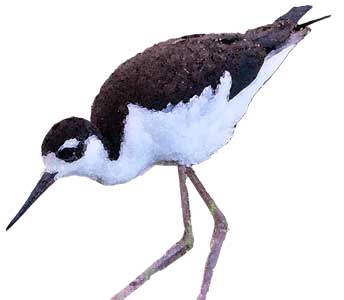
Next time you are driving on I-15 towards Brigham City past Willard Bay, please keep your eyes on the road. But if you can, take the opportunity to drive to and then stop at the ramp at the southeast end of Unit Two of the Refuge. Go on up the easy walkway to the platform. Look to the north in wonder and then look to the south in awe.
High Species Counts at Bear River Bay during the GSL Waterbird Survey from 1998 to 2001
March 13, 2007
By Wayne Martinson, Utah Important Bird Areas Coordinator, National Audubon Society
Bear River Refuge is an incredible area. But, there is also the area to the south of the major dike (D-line) separating the managed part of the refuge from the rest of Bear River. This area is extremely valuable as personal observation indicates and the information below helps demonstrate.
An excellent overview of the ecological setting, waterbird biology and habitat management of the Great Salt Lake and the surrounding wetlands is provided in "Avian Ecology of Great Salt Lake" by Tom Aldrich and Don Paul in Great Salt Lake: An Overview of Change. (Edited by J. Wallace Gwynn, Ph.D., Special Publication of the Utah Department of Natural Resources, 2002.) The following description of Bear River Bay is from this article:
Bear River Bay is the freshest region and receives the largest volume of riverine inflow. Its near-surface salinity is similar to that of the Bear River. This system is bounded on the north and east by state, federal, and private wetlands; on the south by industry; and to the west by the Promontory Mountains. This bay is fresh enough to support a community of submergent hydrophytes including sago pondweed (Potamogeton pectinatus) and widgeon grass (Ruppia maritima). There are significant islands of emergent wetlands here, especially in the east part of the bay in the Willlard Spur. . . . An ecological element of vital importance to pisciverus birds in this area is the fishery that persists when the lake elevation is higher than 4,200 feet (1,280.2 m) above sea level. The avian community at Willard Spur is exceptionally complex. With its species richness, diversity and overall abundance, this area continually provides one of the most magnificent displays of bird life on the lake. Although the smallest region on the lake, it makes an exceptional contribution to the lake's avian population.
The Great Salt Lake Waterbird Survey from 1997 through 2001 had 12 different survey areas in the total Bear River Bay complex, including Bear River Refuge, Public Shooting Grounds, the Bear River Club, and various survey areas in Bear River Bay. A map of these survey areas is provided. The surveys were conducted numerous times from early spring through fall during these five years.
The table below provides high bird counts over 1,000 during the GSL Water Bird Surveys from 1998 through 2001 at Bear River Refuge and the three main survey areas south of the major west to east dike (D-Line) for Bear River Refuge. Immediately below is a brief description of these areas:
1. Bear River Migratory Bird Refuge. This area includes all impounded units and any appropriate habitat with established dike units within the Bear River Bird Refuge. Area is managed by U.S. Fish and Wildlife Service.
2. South Bear River. A large wetland complex south of the D-line in the Bear River Migratory Bird Refuge.
3. Bear River Bay. Open water area of the bay between the railroad causeway on the south and Bear River National Wildlife Refuge on the north. The area was surveyed from an airplane in east-west running transects spaced one mile apart. Observers counted birds on both sides of the plane out to 1/8 mile. To extrapolate to the whole area transect counts were multiplied by four. Public access.
4. Willard Spur. This area is bounded by emergent marsh or sandbar fringe on the north, the Willard Bay reservoir dike on the east, the North Harold Crane dike and emergent marsh on the south, and a line from the northwest corner of GSL Mineral north to the mud bar spit on the south.
Four Survey Sites at Bear River Bay - High Counts above 1,000 from the 1998-2001 GSL Bird Survey.
Taken from a review of 32 species.
Bear River Refuge
|
South Bear River
|
Bear River Bay
|
Willard Spur
|
10,449.4 Hectares
|
8,272.3 Hectares
|
16,467.3 Hectares
|
6,590.3 Hectares
|
| |
|
|
|
| 1. AGWT-52,584 |
1. AGWT-39,723
|
1. WIPH-33,638
|
1. AGWT-5,099
|
2. WESA-52,396
|
2. Gadwall-37,483
|
2. AWPE-26,230
|
2. LBDO-4,382
|
| 3.WIPH-26,541 |
3. Mallard-36,119
|
3. NOPI-17,669
|
3. WIPH-4,210
|
4. AMAV-23,240
|
4. AMAV-18,975
|
4. CAGU-13,740
|
4. AMCO-3,995
|
5. NOPI-18,840
|
5. NOPI-15,209
|
5. LBDO-12,535
|
5. AWPE-3,938
|
6. Mallard-18,838
|
6. WESA-14,004
|
6. CAGO-8,499
|
6. NOPI-3,753
|
7. MAGO-16,956
|
7. AMCO-11,937
|
7. Redhead-7,720
|
7. WFIB-3,592
|
8. NOSH-16,674
|
8. NOSH-11,870
|
8. AGWT-7,492
|
8. AMAV-3,547
|
9. WFIB-16,006
|
9. FRGU-9,575
|
9. NSHO-6,927
|
9. NSHO-2,377
|
10. BNST-14,582
|
10. LBDO-8,245
|
10. AMCO-5,819
|
10. FRGU-2,305
|
11. Gadwall-13,450
|
11. AWPE-8,192
|
11. AMAV-5,318
|
11. MAGO-1,560
|
12. AMCO-10,778
|
12. WFIB-8,120
|
12. BNST-4,986
|
12. RUDU-1,493
|
13. FRGU-9,903
|
13. BNST-7,536
|
13. FRGU-3,752
|
13. Redhead-1,391
|
14. LBDO-5,580
|
14. MAGO-6,918
|
14. EARG-3,213
|
14. EARG-1,285
|
15. CITE-5,145
|
15. WIPH-5,572
|
15. WEGR-3,024
|
15. Mallard-1,161
|
16. EARG-3,032
|
16. EARG-4,055
|
16. WFIB-2,121
|
16. BNST-1,038
|
17. AWPE-3,902
|
17. CAGU-3,186
|
17. Gadwall-1,580
|
|
18. CAGU-3,569
|
18. CITE-1,797
|
18. RBGU-1,556
|
|
19. AMWI-2,929
|
19. WEGR-1,541
|
19. RUDU-1,038
|
|
20. CAGO-2,874
|
20. RUDU-1,168
|
20. RPHA-1,027
|
|
21. RUDU-2,130
|
|
|
|
22. Redhead-1,647
|
|
|
|
23. RPHA-1,600
|
|
|
|
24. LESC-1,271
|
|
|
|
Also Note: High counts of Tundra Swans in winter months of 12,166 at Bear River Refuge and 2,334 at Willard Spur.
The following are a few more comments on the above data.
1. Below, in alphabetical order, are abbreviations for the bird species provided above: AGWT - American green-winged Teal, AMAV - American Avocet, AMCO - American Coot, AMWI - American Widgeon, AWPE - American White Pelican, BNST - Black-necked Stilt, CAGO - Canada Goose, CAGU - California Gull, CITE - Cinnamon Teal, EARG - Eared Grebe, FRGU - Franklin Gull, LESC - Lesser Scaup, LBDO - Long-billed Dowitcher, MAGO - Marbled Godwit, NOPI - Northern Pintail, NOSH - Northern Shoveler, RBGU - Ring-billed Gull, RPHA - Red-necked Phalarope, RUDU - Ruddy Duck, WEGR - Western Grebe, WFIB - White-faced Ibis, WIPH - Wilson's Phalarope, WESA - Western Sandpiper.
2. The high bird counts above are just one way of indicating the value of these four survey areas for numerous bird species.
3. The following are estimates of 1% of the World's population of just four of the species listed above: Green Winged Teal would be 39,000, American Avocet would be 4,500, Long-billed Dowitcher would be 5,000, and Wilson's Phalarope would be 15,000. As you can see the high counts for these four species each exceeded 1% of the estimated world's population for these four species.
4. I have become familiar with the bird GSL bird surveys because they were used for selecting the five major bays of Great Salt Lake as Important Bird Areas. The Important Bird Area (IBA) program is a state, national and worldwide effort to identify, monitor and conserve critical habitat for birds. The Utah IBA program has no administrative or management authority. The five bays of Great Salt Lake have been nominated as globally important bird areas. For more about the IBA program you can go to www.audubon.org/bird/iaba/utah or contact me at
This e-mail address is being protected from spambots. You need JavaScript enabled to view it
.
So, next time you are driving on I-15 towards Brigham City past Willard Bay, please keep your eyes on the road. But if you can, take the opportunity to drive to and then stop at the ramp at the southeast end of Unit Two of the Refuge. Go on up the easy walkway to the platform. Look to the north in wonder and then look to the south in awe.
Click on the link below to download a map.
bear_river_iba 36.59 Kb
|